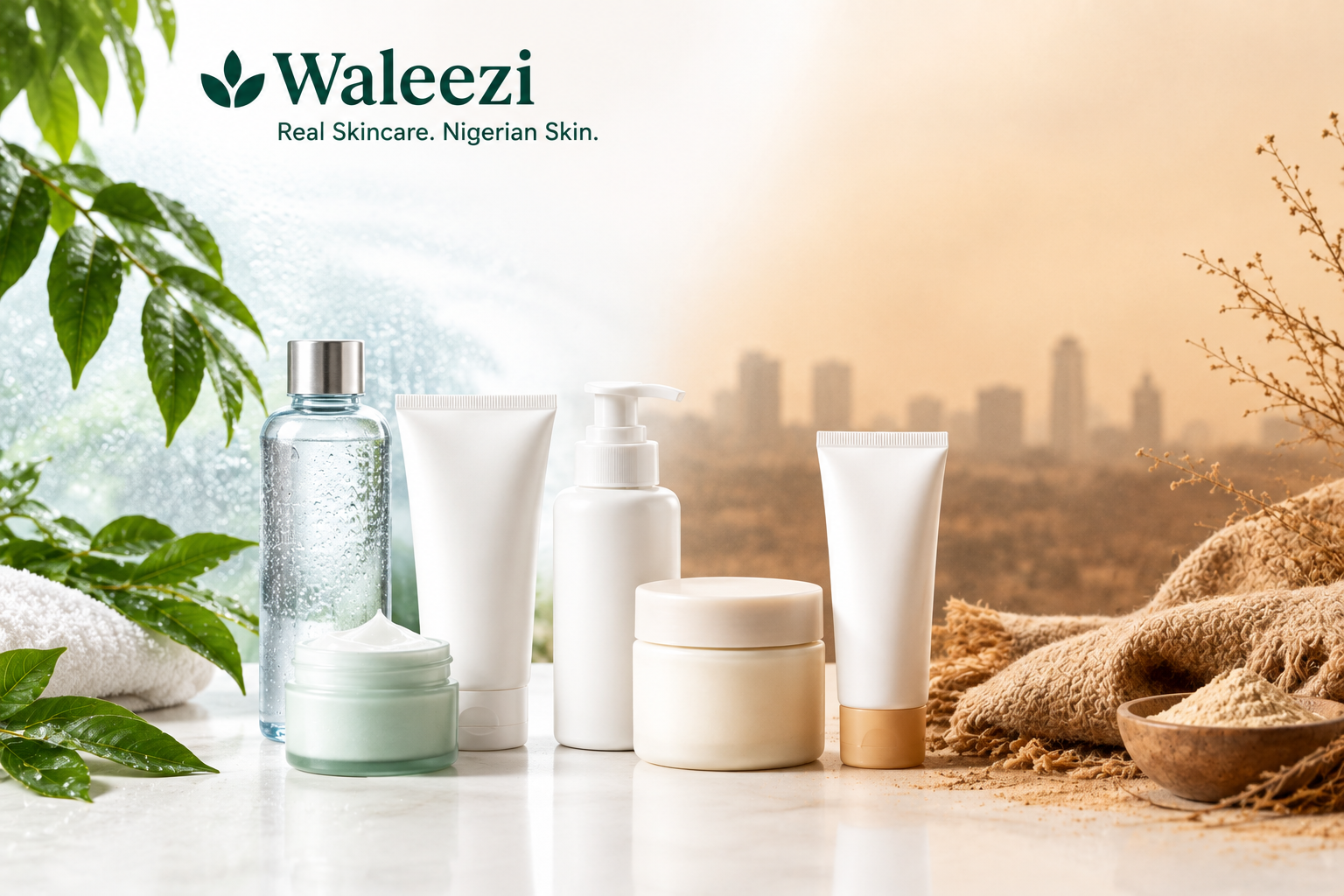
Have you ever noticed that your skin can behave like two completely different people depending on the weather?
One month, your face is shiny by 10 a.m. You wash it in the morning, step outside into the Lagos heat, enter a danfo or bus with the windows barely helping, and before you know it, your forehead is producing enough oil to make you wonder what is happening.
Then Harmattan comes.
Suddenly, that same skin that used to look shiny is feeling tight. Your cheeks may feel rough. Your lips are dry. You apply your usual cream and somehow your face still feels like it needs something else.
And you start asking yourself:
“Wait. What is my actual skin type?”
Am I oily? Dry? Combination? Sensitive? Or has Nigerian weather simply decided to confuse me?
If you have ever felt this way, you are definitely not alone.
I’ve seen this happen to so many people. Sometimes the problem isn’t that someone’s skin has suddenly changed its entire identity. The environment around the skin has changed, and the skin is responding to it.
Nigeria gives us plenty of environmental changes to work with. We have humid mornings, sweaty afternoons, dusty roads, hot markets, air-conditioned offices, rainy seasons, dry Harmattan winds and those strange days when the weather seems to be doing whatever it likes.
So if your skin behaves differently in humid weather compared with Harmattan, don’t immediately conclude that something is wrong. Your skin is living in the same weather you are. And understanding that relationship can make choosing your skincare routine much easier.
In this guide, let’s slow everything down and look at how your skin type may behave in humid weather compared with Harmattan, how to tell what your skin actually needs, and how to adjust your routine without turning your bathroom into a skincare laboratory.
First, What Does “Skin Type” Actually Mean?
Before we talk about humidity and Harmattan, let’s clear up one thing. Your skin type and your skin’s current condition are not necessarily the same thing.
Your basic skin type is usually described as normal, oily, dry or combination. Some people also describe their skin as sensitive, but sensitivity is better thought of as a characteristic or condition of the skin rather than one of the traditional four basic skin types.
Why does this matter? Because your skin can be naturally oily but temporarily dehydrated. You can have combination skin that becomes much drier during Harmattan. You can have dry skin that feels even tighter when exposed to dry air. And someone with oily skin can still experience dehydration.
This is where many skincare routines go sideways. You notice more oil and immediately buy stronger products to “dry out” your face. Or you notice dryness and start piling on five different creams. Sometimes, neither approach is necessary.
Your skin doesn’t have to behave exactly the same every day
Think about your clothes. You don’t wear the same thing to the beach that you wear during a chilly evening. The person inside the clothes is still you. The environment changed. Your skincare can work in a similar way. You may still have oily skin, but your routine might need to feel lighter during hot, humid periods and more comforting during dry Harmattan weather. That’s adjustment, not confusion.
What Humid Weather Does to Your Skin
Let’s start with the weather many Nigerians know very well. Heat + moisture in the air + sweat = a very different skincare experience. When the air contains a lot of moisture, water doesn’t evaporate from your skin as quickly as it might in very dry conditions. Add Nigerian heat and physical activity, and you can also produce more sweat. And then there is sebum, the oily substance naturally produced by your skin. Put all three together and you may suddenly feel like your face is doing overtime.
You may notice more shine
This is one of the easiest things to spot. Your forehead may become shiny. Your nose may look oily. Your cheeks might feel comfortable while your T-zone feels like it has its own weather system. If you have naturally oily or combination skin, humid weather can make that appearance even more noticeable.
But here’s something worth remembering:
Shine doesn’t automatically mean your skin is unhealthy.
Your skin naturally produces oil. The goal isn’t to remove every trace of it. Trying to make your face completely oil-free can leave you constantly fighting your own skin.
Sweat becomes part of the picture
When you’re walking through a hot Nigerian afternoon, sweat is normal. You may notice it around your hairline, upper lip, forehead or neck. If you’re commuting, working outdoors, exercising or spending time in crowded places, your skin can feel even more sweaty. And let’s be honest, Lagos traffic alone can make you question every skincare decision you’ve ever made.
But sweat itself isn’t a reason to panic. Instead, pay attention to how your skin feels afterwards. Does your face simply feel sweaty? Does it feel greasy? Does it feel uncomfortable? Does it feel tight after washing? Those details can tell you much more than looking at shine alone.
What Harmattan Does Differently
Then Harmattan arrives. The air becomes noticeably drier. Dust is everywhere. Your lips may start asking for lip balm before breakfast. Your hands can feel rough. And your face may suddenly feel much less comfortable than it did a few weeks earlier. Harmattan can be particularly challenging for people whose skin already tends toward dryness.
Dry air can make skin feel tighter
When the surrounding air is dry, moisture can leave the skin more readily. You might notice tightness after cleansing, rough-feeling areas, flaking, dry lips, more noticeable dry patches, makeup sitting differently on the skin, and a general feeling that your usual moisturiser isn’t enough. This doesn’t necessarily mean you’ve suddenly developed dry skin. Your existing skin type may simply be responding to a much drier environment.
Harmattan dust adds another layer
Now let’s bring in the Nigerian reality. Harmattan isn’t simply “dry weather.” There is dust. You walk outside and your clothes may collect it. Your windows collect it. Your car collects it. Your skin is exposed to the same environment. That doesn’t mean you need to scrub your face aggressively every evening.
Actually, please don’t.
More scrubbing is not automatically better skincare. Your routine should help remove everyday dirt and product buildup while still being gentle enough for your skin.
So… Can Your Skin Type Change With the Weather?
This is where things get interesting. Your underlying skin type generally doesn’t need to be completely redefined every season. But how your skin behaves can absolutely change. Someone with oily skin may feel less oily during Harmattan. Someone with dry skin may feel even drier. Someone with combination skin may notice that the cheeks become uncomfortable while the forehead remains relatively shiny. And someone who usually considers their skin “normal” may suddenly notice either dryness or excess shine.
Think of your skin type as your starting point. The weather is one of the things that can influence how that skin behaves. Your routine should respond to what you’re actually experiencing rather than forcing your skin into a category.
How to Identify Your Skin Type in Humid Weather
Let’s make this practical. Don’t start by buying anything. First, observe.
Step 1: Wash your face gently
Use a cleanser that you already know works comfortably for you. Don’t scrub aggressively. Don’t use harsh soap just because you want to perform a “skin test.” Clean your face normally.
Step 2: Give your skin some time
After cleansing, leave your skin alone for a little while. Don’t immediately cover it with several products. You are observing how it naturally feels.
Step 3: Pay attention to different areas
Ask yourself a few simple questions. Does my entire face become shiny? That may suggest oilier skin. Does my face feel tight or uncomfortable? That may point toward dryness or temporary dehydration. Is my forehead and nose oily while my cheeks feel normal or dry? That sounds more like combination behaviour. Does my skin feel comfortable without becoming excessively oily or dry? You may have relatively normal skin.
But remember: this is observation, not a diagnosis. Your skin can also behave differently depending on the products you’re using, how often you cleanse, the weather and other environmental factors.
Understanding Oily Skin in Humid Nigerian Weather
If you have oily skin, humid weather can feel like your skin has turned the oil tap all the way up. You may notice more facial shine, oil appearing faster during the day, a greasy feeling around the T-zone, makeup moving around more easily, and the desire to wash your face repeatedly. And that last one deserves attention.
Please don’t wash your face every time it looks shiny
I understand the temptation. You look in the mirror. Your forehead is shining. You wash your face. Two hours later, shine. Wash again. Before long, your face is getting more attention than your actual work. But repeatedly stripping the skin isn’t necessarily the answer. Instead, build a routine that cleanses properly without making your skin feel painfully dry afterwards. A lightweight moisturiser can still make sense for oily skin. Yes, even oily skin needs moisturising. The aim is not to make your face as dry as possible. The aim is to support comfortable, balanced-looking skin.
Understanding Dry Skin in Humid Weather
Dry skin doesn’t disappear just because the weather is humid. You may still experience tightness, rough texture, flaking, dry patches and discomfort after cleansing. You may simply notice these things less than you would during Harmattan. If your skin is naturally dry, don’t assume that humid weather means you should stop moisturising. Instead, you may find that you can use a lighter moisturiser than you would during the driest months. Listen to your skin. If a product feels comfortable and keeps your skin feeling moisturised without feeling heavy, that’s useful information.
Combination Skin: The Nigerian Weather Special
If you have combination skin, you probably know exactly what I’m talking about. Your forehead says “We have oil.” Your cheeks say “Please bring moisture.” And you’re standing in the middle wondering which one to listen to. Combination skin means different areas of your face behave differently. The T-zone — usually the forehead, nose and chin — may be oilier while the cheeks are less oily or even dry. Humid weather can make the oily areas more noticeable. Harmattan can make the drier areas much more uncomfortable. This is why you don’t always need to treat your whole face exactly the same way. You can keep your routine simple while paying attention to individual areas. For example, a lightweight moisturiser may feel comfortable overall, while particularly dry areas may need a little extra moisturising. No need to overdo am.
What About “Normal” Skin?
Normal skin doesn’t mean your skin never has problems. It simply means your skin generally sits somewhere in the middle without persistent excessive oiliness or dryness. Even normal skin can become sweaty during hot weather, dry during Harmattan, uncomfortable after harsh cleansing, or more sensitive to environmental changes. So don’t think, “My skin is normal, therefore weather doesn’t matter.” Weather matters to everybody. The difference is simply how noticeable the changes are.
Why Your Harmattan Routine May Need to Be Different
Let’s say your humid-weather routine is cleanser → lightweight moisturiser → sunscreen. That might feel perfectly comfortable during a humid period. Then Harmattan comes and suddenly you’re thinking, “Why does my face feel dry five minutes after washing?” This is where adjustment makes sense. You may need to consider a gentler cleanser, a richer moisturiser if your skin needs it, avoiding unnecessary exfoliation, paying more attention to dry areas, and keeping your routine consistent rather than constantly changing products. The key word is adjustment. Not replacement. You don’t necessarily need a completely new skincare collection every Harmattan season.
A Simple Humid-Weather Routine
Let’s keep this realistic. You don’t need twelve products lined up on your dressing table.
Morning
A simple routine could look like gentle cleanser, lightweight moisturiser if your skin needs it, and sunscreen. If your cleanser leaves your skin comfortable and you don’t feel particularly oily in the morning, you may not need to aggressively cleanse. The right routine depends on your individual skin and the products you tolerate comfortably.
Night
At night: cleanse your face, apply your chosen treatment product if you use one, and moisturise. That’s it. You don’t have to turn every night into a skincare ceremony. Sometimes simple is exactly what your skin needs.
A Simple Harmattan Routine
During Harmattan, the emphasis can shift toward keeping your skin comfortable and moisturised.
Morning
Try gentle cleansing, moisturiser, and sunscreen. If your skin feels particularly dry, you may prefer a moisturiser with a more comforting texture.
Night
At night: gentle cleanse, treatment if appropriate for your routine, and moisturiser. And if your lips are dry, keep a lip balm nearby. Your lips don’t care that you forgot it at home. They will remind you.
Sunscreen Still Matters During Harmattan
Harmattan can sometimes make the sun feel less intense because of the dusty or hazy atmosphere. But don’t let that trick you into thinking skincare stops needing sun protection. Your sunscreen routine shouldn’t depend entirely on whether the sky looks bright and blue. If you’re spending time outdoors, sunscreen can remain an important part of your daytime skincare routine. And yes, this applies to dark skin too. Having melanin does not mean you don’t need to think about sun protection.
What About Products You Can Actually Buy in Nigeria?
This is where skincare advice sometimes becomes unrealistic. Someone tells you to use a product that costs more than your monthly food budget. My sister, let’s breathe. Skincare doesn’t have to become financial suffering. You’ll find plenty of products in Nigerian pharmacies, supermarkets, beauty stores and online shops. Depending on your skin and budget, you may come across brands such as Simple, CeraVe, Cetaphil, Neutrogena, Nivea, Vaseline, Dove and Palmer’s. There are also many Nigerian and African skincare brands worth exploring.
But don’t buy a product simply because someone shouted its name on TikTok. Look at what the product is designed to do. Consider the texture. Consider the ingredients you already know your skin tolerates. And most importantly, don’t introduce five new products at once. If your skin reacts, you’ll be sitting there asking, “Which one did it?” And now we have a detective case.
Don’t Let “Oily” Make You Afraid of Moisturiser
This deserves its own section because I see this mistake all the time. Someone has oily skin and decides, “No moisturiser for me.” But moisturising and oil production are not the same thing. A moisturiser adds moisture and supports the skin’s outer barrier. It doesn’t automatically mean you’re going to wake up looking like you poured cooking oil on your face. If heavy creams don’t feel comfortable in humid weather, try a lighter texture. You can choose what feels appropriate for your skin. The same person may prefer a lightweight moisturiser during humid weather and something richer during Harmattan. That isn’t inconsistency. That’s paying attention.
Please Don’t Turn Harmattan Into Exfoliation Season
Your skin starts looking rough. You see some flakes. Your first thought is, “Let me scrub everything off.” Please wait. Dry-looking or flaky skin doesn’t automatically mean you need aggressive exfoliation. Scrubbing harder can leave your skin feeling even more uncomfortable. Instead, focus on gentle cleansing and moisturising. If you already use an exfoliating product, consider whether your skin is tolerating your current frequency comfortably. You don’t get extra skincare points for using more.
Common Skincare Mistakes in Nigerian Weather
Now let’s talk about the things I really want you to stop doing. Not because I’m judging you. I’ve made some of these mistakes too.
1. Changing everything at once
New cleanser. New serum. New toner. New moisturiser. New sunscreen. Then your skin starts behaving strangely. Which product caused it? Nobody knows. Introduce changes gradually where possible. Give yourself a chance to understand what works for you.
2. Using harsh soap because your face is oily
Your face looking oily doesn’t mean you need to attack it. A harsh cleanser may leave your skin feeling stripped and uncomfortable. Choose something that cleans without leaving your face feeling painfully tight. That “squeaky clean” feeling isn’t necessarily the goal.
3. Skipping moisturiser because of shine
Oily skin can still benefit from moisturising. If your current moisturiser feels too heavy, look for a lighter option instead of abandoning moisturiser completely.
4. Scrubbing away every dry patch
Harmattan comes. Your cheeks start flaking. You scrub. They still feel dry. You scrub harder. Please don’t. Treat the dryness gently.
5. Copying someone else’s entire routine
Your friend’s skin isn’t your skin. Your favourite influencer’s skin isn’t your skin. Even two people living in the same Lagos neighbourhood can have completely different skin needs. Take inspiration from other people’s routines, but don’t blindly copy everything.
6. Buying products because they promise instant transformation
Be careful with dramatic promises. You don’t need a product shouting that it will completely transform your face overnight. Healthy-looking skin is usually built through consistent, sensible care. Not magic. Not panic. Not fifteen products.
7. Forgetting the rest of your body
Your face isn’t the only skin you have. During Harmattan, your hands, legs, elbows, knees and lips may also become dry. If your body feels dry, moisturise it. Especially after bathing. Your skin deserves attention beyond the face.
How to Adjust Your Routine Without Starting Again From Zero
This is probably the most useful part of the entire article. You don’t need a completely different personality for every season. Instead, start with your basic routine and adjust the texture or intensity depending on how your skin feels.
When the weather is humid, you may prefer lightweight moisturisers, comfortable non-greasy textures, gentle cleansing, less layering, consistent sunscreen, and products that don’t feel overly heavy.
During Harmattan, you may prefer more moisturising textures, gentle cleansing, fewer harsh exfoliating steps, more attention to dry areas, lip balm, and consistent moisturisation.
Notice something? The foundation hasn’t completely changed. You’re simply responding to the weather.
Your Skin Doesn’t Need to Feel “Perfect”
Here’s something I wish more people understood. Your skin is allowed to have texture. It is allowed to get shiny. It is allowed to sweat. It is allowed to have an occasional dry patch. It doesn’t have to look like a filtered Instagram photo to be healthy-looking skin. Especially in Nigeria. You are living in a real environment. You’re walking through dust. You’re dealing with heat. You’re sweating. You’re entering air-conditioned rooms and leaving them again. You’re commuting. You’re cooking. You’re working. You’re living. Your skin is part of all of that. So don’t let social media convince you that every tiny change means your skincare routine has failed.
A Simple Way to Track Your Skin Through the Seasons
If you’re still unsure about your skin type, try keeping a small skincare diary. Nothing complicated. Once or twice a week, write down the weather (humid, dry, Harmattan or rainy), how your skin feels in the morning (oily, comfortable or tight), how it feels in the afternoon (shiny, comfortable or dry), how it feels at night (comfortable, tight or rough), and the basic products you used. After a few weeks, you may start seeing a pattern. Maybe your forehead gets significantly oilier during humid periods. Maybe your cheeks become uncomfortable during Harmattan. Maybe one particular product feels great in one season but too heavy in another. That information is much more useful than randomly changing your routine every few days.
When Your Skin Feels Confusing, Ask These Five Questions
The next time you look in the mirror and think, “What is going on with my face?”, pause and ask yourself these five questions.
First, what is the weather doing? Is it extremely humid, hot, dry or dusty? Has Harmattan arrived?
Second, what did I put on my skin recently? Have you introduced a new product or are you layering more products than usual?
Third, how does my skin actually feel? Don’t focus only on appearance. Does it feel tight, comfortable, greasy or rough?
Fourth, have I been cleansing differently? Maybe you’ve started washing more frequently because of the heat, or maybe you’ve changed your cleanser.
Fifth, am I trying to fix too many things at once? Sometimes the answer is to simplify. Seriously. Your skin doesn’t always need another product. Sometimes it needs fewer things happening to it.
What If Your Skin Seems Dry and Oily at the Same Time?
This is one of the most confusing situations. Your forehead is shiny. Your cheeks feel tight. Your nose looks oily. Your face still feels uncomfortable. What now? First, don’t assume you have to attack the oil and ignore the dryness. Look at the whole picture. You may have combination skin. You may also be experiencing dehydration alongside oiliness. Your routine should therefore focus on keeping the skin comfortable rather than simply trying to eliminate oil. A gentle cleanser, appropriate moisturiser and sensible daytime protection can form a much simpler starting point. And if something persistent or concerning is happening with your skin, that’s when professional skincare or medical advice becomes more appropriate.
What About Air Conditioning?
This one is easy to forget. You may spend your morning outside in humid Nigerian weather and your afternoon inside an aggressively air-conditioned office. Your skin is experiencing two very different environments in the same day. If you work in an air-conditioned environment for long periods, pay attention to how your skin feels. Maybe you notice more tightness. Maybe your lips feel dry. Maybe your moisturiser seems less comfortable than usual. You don’t necessarily need ten new products. Start by observing the pattern. Then adjust your moisturisation if needed.
Your Skincare Routine Should Fit Your Actual Life
I want to say this because skincare advice can sometimes become unrealistic. If your morning is wake up, prepare for work, fight traffic, answer messages, get children ready, run errands, then somehow arrive at work wondering how you got there… you probably don’t need a 14-step morning routine. A routine you can actually maintain is more useful than an elaborate routine you abandon after four days.
For many people, the basics are enough to build around: cleanse → moisturise → protect during the day. Then at night: cleanse → treatment if needed → moisturise. Your exact products can change based on your skin and preferences. But the principle stays simple.
Humid Weather vs Harmattan: A Quick Comparison
| What you notice | Humid weather | Harmattan |
|---|---|---|
| Facial shine | May become more noticeable | May reduce for some people |
| Sweat | Often more noticeable | Usually less prominent |
| Dryness | May be less obvious | Can become more noticeable |
| Skin tightness | May happen after harsh cleansing | Can become more noticeable |
| Moisturiser preference | Often lighter textures | May prefer richer textures |
| Exfoliation | Still shouldn’t be excessive | Be especially careful with over-exfoliation |
| Lips | May feel relatively comfortable | Can become noticeably dry |
| Dust exposure | Depends on environment | Often more noticeable |
| Main focus | Comfort and appropriate lightweight hydration | Comfort and moisturisation |
Remember, this is a general guide. Your skin may behave differently. That’s okay.
The Biggest Lesson: Stop Fighting Your Skin
I know how tempting it is to look at your skin and think, “I need to fix this.” But skincare becomes much easier when you move from fighting your skin to understanding your skin. If it is oily, you don’t have to declare war on oil. If it is dry, you don’t have to panic. If it changes with the weather, you don’t have to assume you’ve suddenly developed a completely different skin type. Observe. Adjust. Keep things simple. And give your routine time to work.
Your Skin Type Is a Starting Point, Not a Prison
You don’t have to find one permanent label and force your skin to behave according to it. Maybe you’re oily most of the year but less oily during Harmattan. Maybe you’re combination and your cheeks need more attention during dry weather. Maybe you’re dry and simply need a more moisturising routine when the air becomes drier. That’s normal. The goal isn’t to make your skin behave exactly the same way throughout the year. The goal is to understand what your skin is telling you and respond sensibly. And honestly, once you start paying attention, your skin can tell you plenty. That tight feeling after cleansing? Information. That sudden increase in shine? Information. Those dry Harmattan patches? Information. You just have to learn how to listen.
Final Thoughts: Your Skin Doesn’t Need You to Panic
If there’s one thing I want you to take away from this article, it’s this:
Your skin can behave differently in different Nigerian weather conditions without you needing to panic.
Humid weather can make oil and sweat more noticeable. Harmattan can make dryness and tightness more obvious. Neither situation means you need to throw away your entire skincare routine and start from scratch. Start with the basics. Learn your skin. Pay attention to how it behaves. Choose products that make sense for your needs and your budget. And don’t feel pressured to buy every product someone recommends online.
When I first started paying closer attention to skincare, one thing became very clear to me: there is no prize for having the longest skincare routine. Sometimes, the routine that works best is the one you can actually understand and stick with. Your skin is yours. Not your friend’s. Not your favourite TikTok creator’s. Not the person selling a product in a dramatic before-and-after video. Yours. So learn it. Give it what it needs. Adjust when the Nigerian weather decides to change the rules. And please, don’t overdo am.
Your skin go thank you.